
Abstract
Pharmacokinetics can be defined as what the body does to a drug. The basic parameters of pharmacokinetics are discussed here including absorption, distribution, metabolism, and excretion. Characteristics and pathways taken by these drugs are determined by these parameters. The mechanism followed by these parameters are also discussed. Furthermore, the factors affecting these parameters including physicochemical factors, physical factors and pharmaceutical factors are also explored. Different routes of drug absorption and main barriers to drug distribution are also explained. The pharmacokinetic values namely acid dissociation constant, bioavailability and solubility are briefly explained. There is a detailed insight into the pathways of metabolism (Phase I and II reactions) and excretion.
Key Words
Pharmacokinetics, Absorption, Distribution, Metabolism
Introduction
Pharmacokinetics can be described as the movement of the drug substance through, into and out of the body. ADME characteristics along with rate and extent are also involved in pharmacokinetics. The pharmacokinetics of a drug depends on many factors that includes its apparent Vd, physicochemical properties, intrinsic clearance, and its interaction with different types of tissues. It serves as a useful tool for not only determining the safety and efficacy of the drug but also for describing the comparison of disposition of formulations and thus can be employed for tailoring compound to a new dosage regimen.
The pharmacokinetic principles can be applied to various biomedical fields like Dosage form evaluation, toxicological studies, Drug formulation evaluation, evaluation of organ function & dosing regimen design etc. Information pharmacokinetic characters of drugs and factors affecting them for designing an effective drug delivery system is very useful.
Basic Parameters of Pharmacokinetics
Ø Absorption
Ø Distribution
Ø Metabolism
Ø Excretion
The onset, duration, and intensity of a drug's effect can be determined by drug pharmacokinetics. Intensity of effect and concentration of the drug are interrelated at the site of action, which depends on its pharmacokinetic properties
Clinical Pharmacokinetics
Application of the principles of pharmacokinetics in the efficient and safe management of the therapeutics drugs
individualized to a patient. The main goal of clinical pharmacokinetics is to decrease the toxicity and enhance the efficacy of the drug.
Absorption
Movement of the drug substance from the site where it is administered to the systemic circulation. The effectiveness of drug can only be assessed by its concentration at site of action. The extent as well as the rate of absorption depend on different parameters.
Mechanism of Drug Absorption
There are 6 major mechanism of drug transport
Transcellular Route
It is the pathway most common for hydrophobic molecules. Hydrophobic properties of such substances allow them to pass through the cell membranes. This process requires energy.
Example
calcium binding proteins transport the calcium ions across the cell membrane by this pathway.
Paracellular Route
It is a pathway in which cells in the epithelium adhere to each other in the monolayers by tight junctions and cell pass through the intercellular spaces between them. It is preferred for hydrophilic molecules and small molecules without expenditure of energy These have specific junctional complexes: Zona occludens, Zona adherens, Desmosomes & Gap junctions
Table 1. Mechanism of Membrane transport
| Passive Diffusion>(Transcellular Route) width="217" valign="top">The drug substance moves from an area of high to lower concentration without the use of any energy. width="176" valign="top">Depends on partition coefficient. If k is greater than 5 easy permeation.>Ficks law of diffusion describes concentration gradient. | > Carrier>Mediated >Transport>Facilitated Diffusion>Active Transport width="217" valign="top">In this mechanism the solute molecules get bind to carrier either reversibly or via noncovalent bond to get transported.>No energy is required as concentration gradient is the driving force.>The driving force is against the concentration gradient called uphill transport as energy required. width="176" valign="top">Metabolic poisons affect them.>Metabolic poisons affect energy production so does not affect them.>Metabolic poison blocks them. | > Pore Transport>(Paracellular Transport) width="217" valign="top">Absorption of water soluble and low molecular size drugs through small pores or narrow channels filled with water width="176" valign="top">Osmotic or Hydrostatic force is the driving factor.>Depend on molecular size should be low. | > Ion pair Formation>(Paracellular Transport) width="217" valign="top">When ionized drug binds to an oppositely charged ion where overall charge is neutral. width="176" valign="top">Neutral drug complex diffusion is easy. | > Endocytosis>Phagocytosis>Pinocytosis>Transcytosis width="217" valign="top">Extracellular material is engulfed by the cell using the part of cell membrane forming the vesicle.>It is adsorptive uptake of solid particles.>It is uptake of fluid solute.>Endocytosis vesicle is transferred from one extracellular compartment to another. width="176" valign="top">Formation of phago-lysosome.>Vesicle formation>Transport of vesicle |
Factors Affecting Drug Absorption
Physicochemical Factors
Table 2. Physicochemical Factors that Affect the Rate and Extent of Absorption
| Drug Solubility and Dissolution Rate width="303" valign="top">Drug should be permeable through the cellular membranes and should be soluble for complete drug absorption. | > Particle size width="303" valign="top">Smaller particle size results in greater surface area that increases the dissolution rate and as a result absorption is increased. | > Polymorphism and Amorphism width="303" valign="top">As a drug can exist in more than one form having different physical properties that affect dissolution rate and absorption. | > Pseudo polymorphism width="303" valign="top">Hydrates and Solvates are present that have entrapped solvents.>Solvates are more soluble and have increased absorption. | > Salt of Drug width="303" valign="top">It may increase or decrease absorption depending on drug. | > Lipophilicity of Drug width="303" valign="top">It depends on oil-water partition coefficient the increase in value indicates increase in percentage drug absorbed. | > pKa of Drug and Gastrointestinal pH width="303" valign="top">Henderson-Hassel Bach equation. | > Stability of Drug width="303" valign="top">Orally used drugs may degrade when administered due to first pass effect. |
Figure 1
Henderson-Hasselbalch Equation

Physical Factors
Route of Administration
There are different routes of administration that effect the absorption of drug. The main routes are oral, parenteral, sublingual, Topical route, Enteral routes.
Bioavailability
Bioavailability is a type of absorption in which the drug concentration enters the circulation when administered
in body and act on the specific organ to produce the desired effect. In the given diagram the bioavailability of intravenous administration is 100% as it directly reaches the systemic circulation while that of oral is less as it may encounter a number of processes as first pass metabolism.
Pharmaceutical Factors
Table 3. Pharmaceutical Factors that Affect the Drug Absorption
| Disintegration Time width="304" valign="top">Low disintegration time is required for rapid absorption.>It depends on amount of binder and compression force. | > Dissolution Time width="304" valign="top">It affects the drug absorption as to be absorbed a drug needs to solubilize in a specific solvent. | > Manufacturing variable width="304" valign="top">Drug dissolution is influenced by manufacturing processes.>Wet granulation but it has several limitations so is replace by direct compression force and affects dissolution and absorption depending on drug. | > Pharmaceutical ingredients>Vehicle>Diluent>Binder>Disintegrant>Lubricant>Suspending Agent>Coating width="304" valign="top">As the number of excipients increases the dissolution becomes complex. Miscible vehicles cause rapid absorption.>Hydrophilic diluents impart absorption while hydrophobic diluents retard absorption.>Hydrophilic binders enhance dissolution while an increase in binder amount retards absorption.>Mostly hydrophilic in nature as amount of disintegrant decreases bioavailability lowers.>Hydrophobic in nature and inhibits dissolution and disintegration.>The dissolution rate depends on type of coating as dissolution of enteric coated is least. | > Nature of Dosage Form width="304" valign="top">The absorption depends directly on the type of dosage form as the bioavailability of solution is highest and that of sustained release products is lowest. |
Other Factors
Table 4. Some Unpredictable Factors that can Alter the Drug Absorption
| Age width="346" valign="top">High stomach ph and less flow of blood in GIT in infants and in elder patients gastric emptying time is altered and GIT blood flow is less so pattern of absorption is altered. | > Gastric Emptying Time>(The process by which food leaves stomach and enters duodenum) width="346" valign="top">Rapid Gastric Emptying Time required when drug is absorbed from distal parts of intestine. Prolong time is required when drugs are absorbed from proximal parts. | > Intestinal Transit Time>(The time taken by food to travel from mouth to intestine) width="346" valign="top">Delayed Intestinal Transit is desirable for sustained release products, enteric coated formulations, drugs dissolved from specific sites of intestine. | > Gastrointestinal pH width="346" valign="top">Drugs absorption takes place in different parts of stomach depending on their pH. | > Disease State width="346" valign="top">Gastric Diseases as Achlorhydric patients have decreased drug absorption. Cardiovascular diseases influence bioavailability of drug and result in decrease drug absorption. | > Blood Flow Through GIT width="346" valign="top">Absorption of polar molecules does not depend on blood flow, but absorption of lipid soluble molecules depends on blood flow. | > GIT Contents width="346" valign="top">Food-food Interactions affect the intestinal pH and solubility of drugs. Fluid Volume when large causes better dissolution and better absorption. It can interact with other GIT constituents as mucin a protective layer of polysaccharide that react with drug streptomycin. | > Presystemic Metabolism>The metabolism of the drug before it reaches the systemic circulation via the eliminating organs e.g. liver. width="346" valign="top">Luminal Enzymes as pepsin, Lipases etc. result in degradation of food and effect absorption. Gut wall Enzymes called mucosal enzymes as Alcohol dehydrogenase that inactivates ethanol. Bacterial Enzymes and Hepatic enzymes also effect absorption. |
Distribution
It is a process in which the drug moves reversibly from the blood to the extracellular tissues and fluid and move back to blood. Driving force is the concentration gradient indicating that it’s a passive process.
Distribution of a drug is a useful parameter as it changes the amount of the drug available at the site of action altering the pharmacological action of the drug.
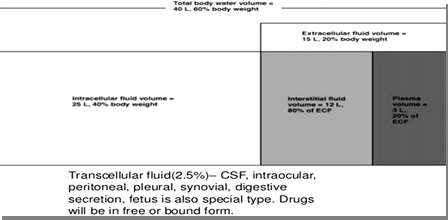
Drug Distribution in Different Body Compartments

Table 5: Body Compartments Distribution and some Drugs having Affinity for Specific Compartments
| Body compartments width="279" valign="top">Types of drugs | > Total body water width="279" valign="top">Small, hydrophilic alcohol and antipyrine | > Extracellular space width="279" valign="top">Large hydrophilic mannitol | > Intravascular space width="279" valign="top">Very large, largely protein bound, heparin | > Body fat width="279" valign="top">Highly hydrophobic DDT and thiopentone | > Bones width="279" valign="top">Fluoride and lead |
Volume of Distribution
The volume of the fluid in which the drug is distributed after administration. The distribution of the drug across the extracellular tissues and blood stream (plasma) can be quantified using the apparent volume of distribution.
Vd = Dose of drug given (Q)
----------------------------------------
Drug plasma concentration (Cp)
Apparent Volume of Distribution of some Drugs
Table 6: Some Common Drug’s Apparent VD
| Drug width="204">Liter/KG width="231">Liter/70 KG | > Choloroguine width="204">94-250 width="231">94-250 | > Nortriptyline width="204">211 width="231">500 | > Digoxin width="204">7 width="231">500 | > Lidocaine width="204">1.7 width="231">120 | > Theophylline width="204">0.5 width="231">35 |
Special compartments for drug distribution
Table 7. Special Compartments-Based distribution of some Drugs
| Reservoirs width="210" valign="top">Details width="219" valign="top">Example | > Cellular > width="210" valign="top">Skeletal muscles, heart>Thyroid >Liver width="219" valign="top">Digoxin>Iodine>Chloroquine | > Fats width="210" valign="top">Highly lipid soluble drugs width="219" valign="top">Thiopentone sodium | > Transcellular width="210" valign="top">Aqueous humour>Joint fluid width="219" valign="top">Chloramphenicol>Ampicillin | > Bones width="210" valign="top">- width="219" valign="top">Tetracyclines, calcium |
Physiological Barriers to Drug Distribution
BBB (Blood brain barrier)
Firmly joined by tight junctions, then capillary endothelium. Few pores between cells. (Limits passage of drugs to brain). Intracellular or transcellular transport is the principle route for drug penetration into brain.
Lipid soluble substances diffuse across brain capillaries based on lipid/water coefficients. Partially ionized, and moderate lipid soluble drugs cross slowly. Restricts small polar molecules and macromolecules.
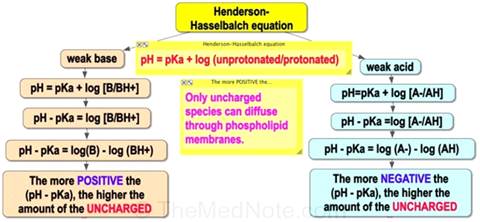
Figure 3
Drug Permeability

Blood CSF Barrier
Choroid plexus is formed by third, fourth and lateral ventricle. Tight junctions are present in between the choroid cells although the open junctions are present in the capillary cells lining the choroid plexus but still only the lipophilic and non-ionized drugs are able to cross it.
It is not connected with tight junction. Penicillin belonging to less lipophilic category can only cross the BBB when administered via the intrathecal route and then they can treat the diseases of the brain.
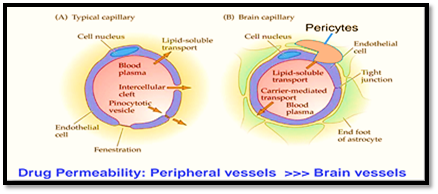
Figure 4
Blood-CSF Barrier

Placental Barrier
Most lipid-soluble drugs readily move from mother to fetus (Diazepam), whereas water-soluble drugs move more slowly. Highly polar or ionized drugs are more limited (Heparin). Has several placental transporters that facilitate or block transfer? The Placenta is not an effective barrier in protecting a fetus. Many Drugs can cross placenta and result in therapeutic, toxic, or teratogenic effects.
Table 8. Drugs that can Cross Placental Barrier
| Drugs width="273" valign="top">Effect on fetus | > Methotrexate width="273" valign="top">Hydrocephalus: neural tube defects | > Phenytoin width="273" valign="top">Cleft lip and palate: cardiac defects | > Aminoglycosides width="273" valign="top">Cochlear and vestibular damage | > Carbimazole width="273" valign="top">Goiter: hypothyroidism | > Warfarin width="273" valign="top">Nasal hypoplasia; epiphyseal calcification |
Metabolism
Biotransformation means chemical alteration of the drug from one form into another to make the nonpolar drug to polar in order to excrete it from the body.
Sites of Metabolism
· Liver is the main site of metabolism
· Kidney, lungs, plasma, intestine and Skin also contribute to the metabolism of drugs.
Biotransformation of Drug
It basically converts lipid soluble drugs to water soluble drugs
Consequences of Biotransformation
· Active drug to inactive metabolite
· Active drug to active metabolite
· Inactive drug to active metabolite
Chemical Pathways of Biotransformation
A. Non synthetic / Functionalization/ Phase I
B. Synthetic / Conjugation/ Phase II
Phase I Reactions
Oxidation, Reduction, Hydrolysis, Cyclization & Decyclization
Phase II Reactions
Glucuronide conjugation, Acetylation, Methylation, Sulfate conjugation, Glycine conjugation, Glutathione conjugation & Ribonucleotide / Ribonucleoside synthesis
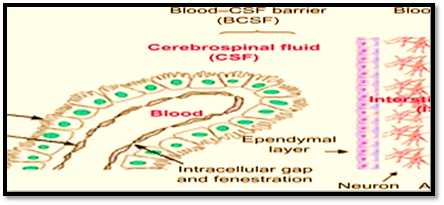
Figure 5
Drug Metabolism

Phase I Reactions
Oxidation
Oxidation is the oxygen being added or by the loss of the electrons. It can make some unstable intermediates for example quinones and epoxides.
Reduction
It is the gain of electrons, oxygen being removed
a) Microsomal reduction
b) Non-microsomal reduction
c) KETO Reduction
d) AZO Reduction
Hydrolysis
Water is added to breakdown the drug substance. It is of two types.
a) Microsomal hydrolysis
b) Non microsomal hydrolysis
Cyclization
A process in which a straight chain compound is transformed to a closed ring type structure.
Decyclization
A process in which the closed ring structure of a drug substance is transformed to open structure.
Phase II Reactions
Conjugation
Drug or metabolite of phase 1 binds with endogenous substance produced by either the proteins or the carbohydrates. Functional groups of these two are joined by the covalent bonds.
Conjugation with Glucuronic Acid
Carboxylic acid containing drugs are eliminated and metabolized significantly through this route.
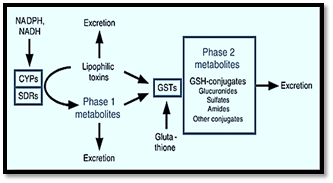
Figure 6
Glucuronic Acid Conjugation

Acetylation
The process of introducing an acetyl group as a substitution for hydrogen atom is termed as acetylation.
Sulphate Conjugation
It is a process in which endogenous and exogenous are metabolically conjugated with sulphate(-SO3?).
Glycine Conjugation
In order to assist the excretion of the substances via the urinary route this process increases the solubility of organic acids in water. For example: Benzoic acid
Glutathione Conjugation
Glutathione combines with toxic substances and converts them into mercaptates that are water soluble. Acetaminophen and nicotine are detoxified very effectively via this pathway. Drug groups-Epoxide, Quinone
Methylation
The addition of methyl group to DNA molecule that tends to change its activity.
Ribonucleotide /Ribonucleoside Synthesis
Action of Purine & Pyrimidine antimetabolites (6 Mercaptopurine)
Excretion
Excretion is a process through which drugs substances are irreversibly transferred from the inside to the outside of the body.
Organs Involved in Excretion
Kidneys, lungs, saliva, skin, intestine as well as biliary system.
Types of Excretion
There are two types of the excretion broadly
? Renal excretion
? Non-Renal excretion
1. Salivary excretion
2. Mammary excretion
3. Dermal excretion
4. Biliary excretion
5. Pulmonary excretion
Renal Excretion
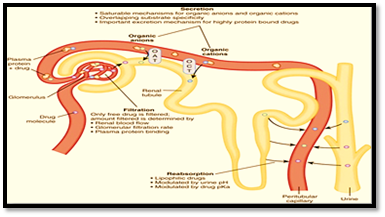
Most water soluble as well as non-volatile drugs are excreted primarily from the kidney. The urinary excretion of a drug is determined by three major processes
• Filtration via Glomerulus
• Active Tubular secretion
• Tubular reabsorption
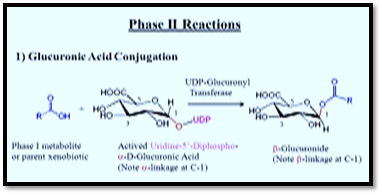
Figure 7
Drug Excretion

Glomerular Filtration
High degree filtration of the fluid is achieved through pores present in the capillary wall of the glomerulus and it resist the flow of substances of high Mr. through it. Plasma proteins are prevented through the selective filtration required to maintain the volume of the plasma for example albumin and globulin. Shape, charge and molecular weight affect the filtration of large molecules through the glomerulus. Until these requirements are fulfilled, unbound drugs continue to be filtered through the glomerulus. 20 to 40 angstrom compounds are efficiently filtered through glomerulus. Glomerular filtration rate is usually ml per minute.
Active Tubular Secretion
Many drugs that are not filtered across the glomerulus tends to be secreted by the active secretion from the blood into the kidney tubules. It is energy dependant process that carries the substances against their concentration gradient using carries or transporters.
Table 7. Drugs Transported by Anionic and Cationic Transporters
| Organic Anion Transport width="259" valign="top">Organic Cation Transport | > Acetazolamide width="259" valign="top">Acetylcholine | > Bile salts width="259" valign="top">Atropine | > Hydrochlorothiazide width="259" valign="top">Cimetidine | > Furosemide width="259" valign="top">Dopamine | > Indomethacin width="259" valign="top">Epinephrine | > Penicillin G width="259" valign="top">Morphine | > Prostaglandins width="259" valign="top">Neostigmine | > Salicylate width="259" valign="top">Quinine |
Active Tubular Reabsorption
Some drugs depending upon their ionization at the ph of the urine as well as their lipophilic character are reabsorbed by the passive diffusion after being filtered by the glomerulus. Therefore, the lipophilic drugs are about 99% reabsorbed from the kidney tubules and hydrophilic drugs being soluble in urine and highly ionized are eliminated via urine. Reabsorption via active transport is important for the ions, amino acids, and glucose because they are endogenous substances required by the body.
Biliary Excretion
Hepatocytes secrete the bile juice at the rate of to 5ml per minute and it is essential for the breakdown of fats and subsequently their digestion. Excretion depends upon the polarity of the substance and metabolites being more polar are secreted more than their parent drug. MW > 300 means large molecules are excreted through the bile juice. Some drug substances mostly glucuronides are metabolized by the hydrolysis done by the intestinal bacteria into the parent compound which undergoes enterohepatic circulation.
Table 8. Drugs that Undergo Enterohepatic Recirculation
| Adriamycin width="234" valign="top">Methadone | > Amphetamine width="234" valign="top">Metronidazole | > Chlordecone width="234" valign="top">Morphine | > 1,25-Dihydroxyvitamin D3 width="234" valign="top">Phenytoin | > Estradiol width="234" valign="top">Polar Glucuronic Acid Conjugates | > Indomethacin width="234" valign="top">Polar Sulfate Conjugates | > \Mestranol width="234" valign="top">Sulindac |
Drug’s long persistence in the body partly depends upon enterohepatic cycling. Orally administered activated charcoal and/or anion exchange resins have been used clinically to interfere enterohepatic cycling and trap drugs in the gastrointestinal tract.
Pulmonary Excretion
Gases and other volatile substances are excreted by lungs, irrespective to their lipid solubility. Alveolar transfer of the gas/vapor mainly depends on its partial pressure in the blood. E.g.: Alcohol, general anaesthetic etc.
Excretion in Other Body Fluids
Saliva
Un-ionized lipid-soluble form of the drugs are excreted by the passive means. Substances excreted into saliva are usually swallowed so their fate resembles as that of orally administered. E.g.: caffeine, metronidazole, alcohol etc.
Milk
Lactic secretions are mainly present in milk so rich in fats and proteins with pH 7.0 0.5 to 1 litre of the milk is
secreted in lactating mothers. Low-molecular weight un-ionized water-soluble drugs will diffuse by passive transport across the mammary epithelium and transfer into milk.
Conclusion
In conclusion, an overview of the pharmacokinetics is discussed. The basic parameters of pharmacokinetics are discussed to give an insight into the appropriate applications of ADME properties. In this review article important ADME factors are discussed that wholly described the concept of pharmacokinetics affecting the body as well as determining the safety and efficacy of a particular drug candidate. Knowledge about pharmacokinetic parameters have always emerged as important for providing optimal pharmaceutical care.
Figure 2
References
- Eason, C. T., Bonner, F. W., & Parke, D. V. (1990). The importance of pharmacokinetic and receptor studies in drug safety evaluation. Regulatory Toxicology and Pharmacology, 11(3), 288-307.
- Foti, R. S. et al (2015).
- Danhof, M. (2015). Kinetics of drug action in disease states: towards physiology-based pharmacodynamic (PBPD) models. J. Pharmacokinet. Pharmacodyn. 42, 447- 462
- Jones, H. M., Mayawala, K. & Poulin, P. (2013). Dose selection based on physiologically based pharmacokinetic (PBPK) approaches. AAPS J. 15, 377- 387.
- Morgan, P. et al (2012). Can the flow of medicines be improved? Fundamental pharmacokinetic and pharmacological principles toward improving phase II survival. Drug Discov. Today. 17, 419- 424.
- Rowland M, Benet, L. Z., & Graham, G. G. (1973). Clearance concepts in pharmacokinetics. J Pharmacokinet Biopharm. 1(2):123-36.
- Rowland, M., Lesko, L. J. & Rostami-Hodjegan. (2015). A. Physiologically based pharmacokinetics is impacting drug development and regulatory decision making. CPT Pharmacometrics Syst. Pharmacol. 4, 313-315.
Cite this article
-
APA : Naseem, U., Iqbal, F., & Shahnaz, G. (2016). A Comprehensive Insight on Pharmacokinetics. Global Drug Design & Development Review, I(I), 27-37. https://doi.org/10.31703/gdddr.2016(I-I).04
-
CHICAGO : Naseem, Urooj, Fatima Iqbal, and Gul Shahnaz. 2016. "A Comprehensive Insight on Pharmacokinetics." Global Drug Design & Development Review, I (I): 27-37 doi: 10.31703/gdddr.2016(I-I).04
-
HARVARD : NASEEM, U., IQBAL, F. & SHAHNAZ, G. 2016. A Comprehensive Insight on Pharmacokinetics. Global Drug Design & Development Review, I, 27-37.
-
MHRA : Naseem, Urooj, Fatima Iqbal, and Gul Shahnaz. 2016. "A Comprehensive Insight on Pharmacokinetics." Global Drug Design & Development Review, I: 27-37
-
MLA : Naseem, Urooj, Fatima Iqbal, and Gul Shahnaz. "A Comprehensive Insight on Pharmacokinetics." Global Drug Design & Development Review, I.I (2016): 27-37 Print.
-
OXFORD : Naseem, Urooj, Iqbal, Fatima, and Shahnaz, Gul (2016), "A Comprehensive Insight on Pharmacokinetics", Global Drug Design & Development Review, I (I), 27-37
-
TURABIAN : Naseem, Urooj, Fatima Iqbal, and Gul Shahnaz. "A Comprehensive Insight on Pharmacokinetics." Global Drug Design & Development Review I, no. I (2016): 27-37. https://doi.org/10.31703/gdddr.2016(I-I).04